
Holmesdale Tunnel (LED Retrofit)
Project Details
684m long Holmesdale Tunnel opened in 1984 and was initially refurbished in 2010 with high-pressure sodium lamps as LED luminaires were not viable at the time. With advancements in LED technology, a new retrofit solution now provides significant benefits such as annual energy savings and, of course, CO2 reductions predicted to be greater than 60%.
Applications
- Tunnel Projects
Products Used
Project Gallery

Overview
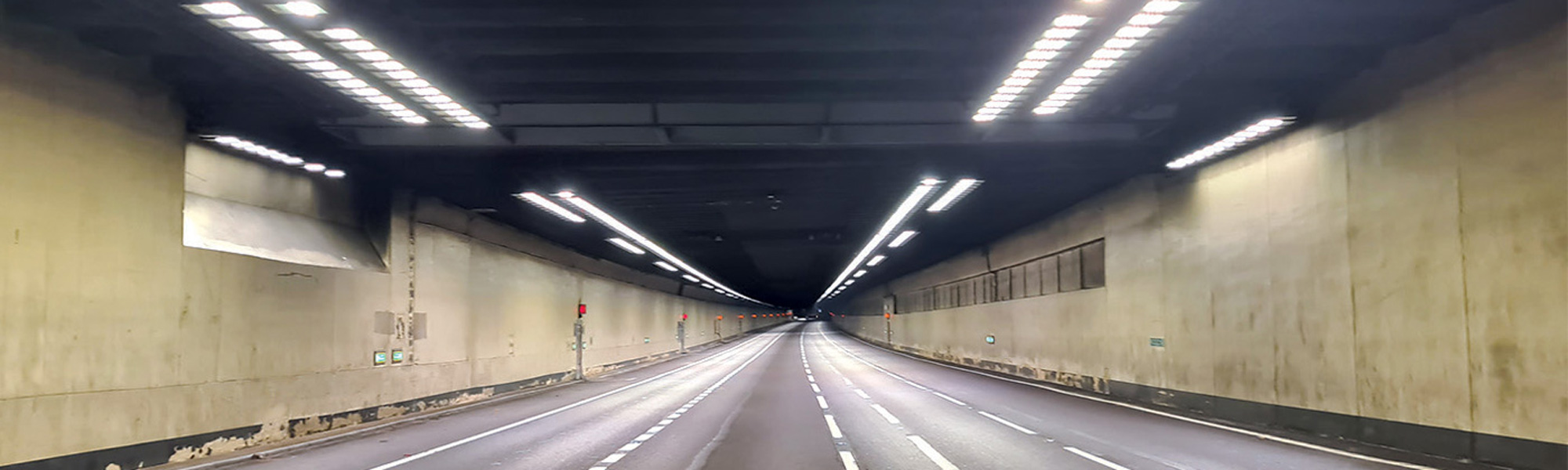
Holmesdale Tunnel, located on the northern stretch of the M25, is approximately 684m in length. The tunnel is of a cut-and-cover structure, first constructed and opened in 1984 and is designed to carry a multi-lane motorway through an existing residential area of north London.
The original lighting installation was first refurbished in 2010, some 26 years after the original opening of the tunnel and, at the time, LED lighting technology for this type of application was in its infancy and not considered viable.
As a result, the 2010 refurbishment featured high-pressure sodium lamps and control gear for all lighting levels with the varying demands for the daytime boost lighting being accommodated by switching lamps on and off in stages.
Since the first refurbishment, advances in LED technology have, of course, experienced an exponential rise in terms of significant improvements in thermal management and increases in luminous flux.
These advancements meant that a further refurbishment was felt viable, even though the tunnel was only 12 years into the projected lifetime of the previously refurbished system.
It was recognised that switching to LED could bring with it significant commercial and operational benefits, which could be realised immediately.
Solution
In January 2021, TRT were appointed by PDS in collaboration with Balfour Beatty Kilpatrick to develop a new, LED retrofit solution, which was designed to replace the high-pressure sodium lamp-and gear combination within the existing competitor luminaire carcasses, which were deemed mechanically sound and still fit for purpose.
The project, which was completed over a duration of 11 months, allowed for an easy conversion to a modern and highly efficient LED solution without the excessive and sometimes prohibitive expense of a complete refit.
The LED technology used in the retrofit units was rigorously tested within our LIA accredited laboratory to ensure that, prior to overall installation commencing, the thermal operation of the electronics, the photometric performance enabling delivery of light to the road and wall surfaces, and the efficacy and projected lifetime requirements all achieved the best possible results.
All testing was conducted with the complete system mounted inside the existing luminaire housing currently installed within the tunnel.
From an operational perspective, all the 2,600+ retrofit LED trays and light engines were integrated with, and controlled by, a new PDS Scanlight Eco+ lighting control system, so allowing the multiple light levels in the tunnel to exactly match the required lumen delivery demand.
During daytime, when light demand in a tunnel is at its highest, all LED light engines remain illuminated in their ‘boost’ mode and dimmed to the exact level to accurately match the luminance level required.
This provides excellent uniformity levels across the carriageway while also negating the large inrush currents on the electrical network, which are prevalent with traditional switch-staged tunnel lighting systems
Comparing Performance
When comparing the before and after LED refurbishment scenario, based on a like-for-like operational cycle throughout the year, the annual energy savings and, of course, CO2 reductions are projected to save more than 60% of the high-pressure sodium system previously in operation.
Prior to the global energy price increases this presented a payback against the lighting system capital outlay of fewer than three years.
In addition to the energy and environmental saving achievements of the LED retrofit, the physical elements of prolonging the operational lifetime of the lighting system and significantly reducing the maintenance cost cannot be ignored.
This includes all the operational and cost benefits this refurbishment has achieved. For example, reutilising the existing luminaire housings was a significant factor during the whole process, ensuring that the waste element of the project was reduced to just the correct disposal method of the redundant lamps and control gear components.
We all understand that switching to LED and prioritising circular economy approaches are not by themselves going to solve either the current energy crisis or climate change. But they can, and do, help.
This project shows that, even in a challenging lighting environment such as tunnels, it is eminently possible to successfully deliver a lighting system that embraces the circular economy ‘3Rs’ of reuse, repurpose and renew.
A great project to be involved in, working alongside our partners TRT & Balfour Beatty Kilpatrick to provide an innovative solution which not only gave our client substantial energy savings but also enabled the reuse of existing infrastructure. With close collaboration between our engineering teams, technical issues
were overcome and despite several unexpected challenges, the project was a great success. Well done to everyone involved.
Tim Whiteley Senior Solutions Manager – PDS Infrastructure Systems